Agnès Pe
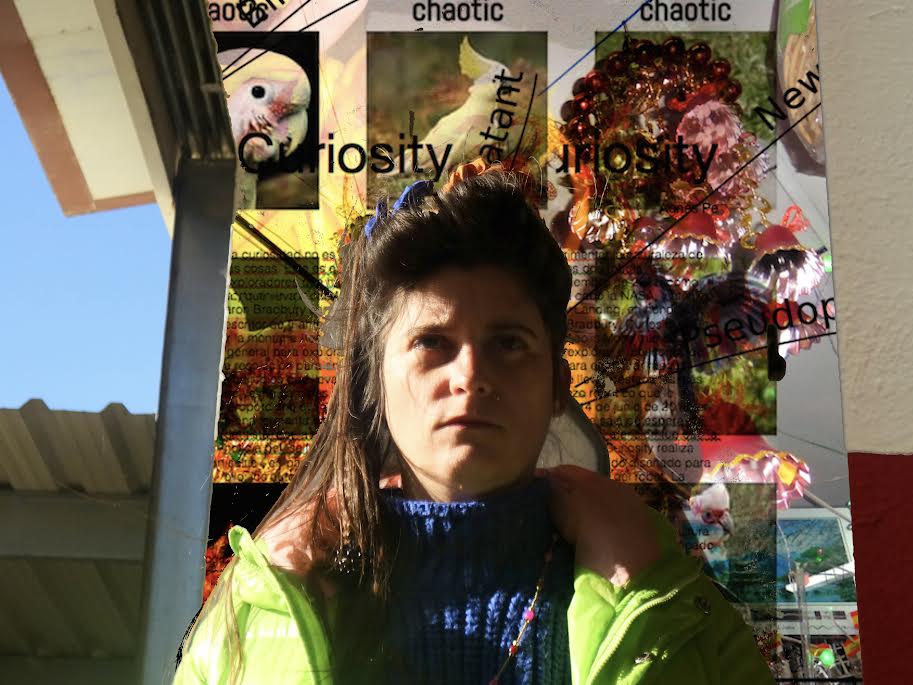
Agnès Pe develops her artistic practice at the intersection of sound experimentation, digital artifacts, and subversive pop culture. She works with sound as raw material, exploring its ability to challenge conventions, provoke dissonance, and generate new narratives. Her work focuses on forgotten sound infrastructures, technological errors, and obsolete devices, which she rescues and transforms into creative tools. Through sound collage, plunderphonics, and digital alteration, she offers a critical reinterpretation of music and its social function. She conceives creation as a playful and experimental process that does not seek closed answers, but rather spaces of friction and engagement with the listener’s expectations. Her practice moves between sound art, experimental radio, and public space, always searching for alternative forms of sound dissemination and reception.
For her performance at the festival she will present ‘Doo, who, rrrr or brrr. A masquerade symphony’
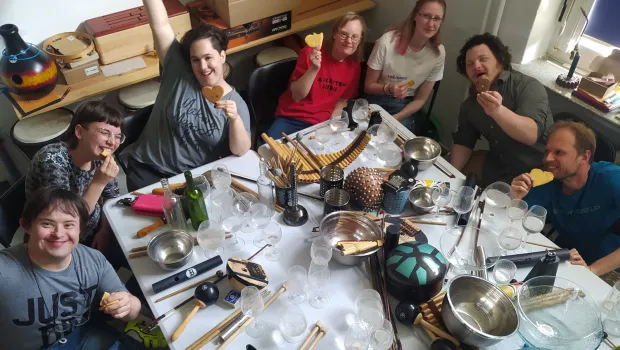
‘Doo, who, rrrr or brrr. A masquerade symphony’ is a composition that was developed to be played for 6 and an infinite number of people utilising only kazoos. It premiered in Manila on 7 November 2019, and was intended to be performed by people who have no knowledge of musical notation. The cyclical structure of the composition is inspired by “Pagsamba” by Filipino composter José Maceda, which was composed for a mixed group of 100 voices and various instruments and bamboo gongs, with performers arranged around the room. Like Maceda’s piece, every person in the room will hear the piece differently due to the spacial arrangement of players.
“The kazoo is perhaps more accurately understood as a vocal distortion device than an instrument. When a musician plays a kazoo, s/he hums into it and that causes a thin film to vibrate. This vibration changes with the sound of the voice giving it the buzzing quality, which is unique to the kazoo. While the instrument may never get the recognition of the guitar, the tuba or the violin, the kazoo is still the only instrument just about anyone can learn right off the bat. If we consider the kazoo’s function of masking voices, we may understand it as a sonic masquerade. The whole idea behind the instrument is, that a kazoo player by singing or speaking through the instrument induces an air current which makes the membrane vibrate and thus creates a summing, “nasal” sound. While the instrument may never get the recognition of the guitar, the tuba or the violin, the kazoo is still the only instrument just about anyone can learn right off the bat.
The kazoo is perhaps more accurately understood as a vocal distortion device than an instrument. If we consider the kazoo’s function of masking voices, we may understand its presence in this song as revealing that all the characters are actually in masquerade. The Kazoo is a folk instrument, but not in the historical sense of the word. Is a folks instrument since it is not part of the western “high culture” standards. Furthermore, it has a funny and phony relation with the concept of folk music, since it was produced as an industrial object in the era ethnomusicology itself was being born. Certainly, in contemporary culture, the sound of the kazoo is understood as irreverent, teasing, and possibly disruptive. These days the kazoo is a divisive instrument, and it seems to live its life mostly as a novelty toy handed out at children’s parties.” – Agnes Pe